Off Sámara we fish for three kinds of marlin: blue, black and striped. From the boat they can look alike, especially in the first seconds of a bite. Here is how the crew tells them apart, how to know a marlin from a sailfish, when they are around, and what happens to every one of them.
Striped marlin
The striped marlin is the slimmest of the three, with a tall, pointed fin on its back and bright blue vertical stripes along the body that light up during the fight. It spends a lot of time near the surface and jumps often, so you usually get a good look at it. It is a common marlin along Costa Rica's Pacific coast.
Blue marlin
Blue and black marlin can both grow much larger than striped marlin. The back is deep cobalt blue, the belly silver, and the fin on the back is pointed but lower than a striped marlin's. The body is rounder and heavier. Blue marlin are the fish many anglers travel for, and the fight with a big one can be long.
Black marlin
The black marlin is the easiest to recognize once it is next to the boat: its side fins, the pectoral fins, are stiff and cannot fold flat against the body. The fin on the back is low and short, and the body is deep and heavy. Blacks are dark blue to black on top rather than bright blue.
Or is it a sailfish?
The sailfish has a huge fin along its back, taller than its body, and a lighter, slimmer shape. No marlin has a fin that tall. A sailfish is also usually smaller than a marlin. If the fin behind the bait looks like a sail, it is a sailfish. Our sailfish guide has more.
When marlin are around Sámara
Marlin are at their best from March to May, and August can also bring good marlin fishing. From December to February they can be caught, but less often. Sailfish are strongest from December to April. These are patterns we see, not promises. If marlin are the reason for your trip, tell us before you choose dates.
All are released
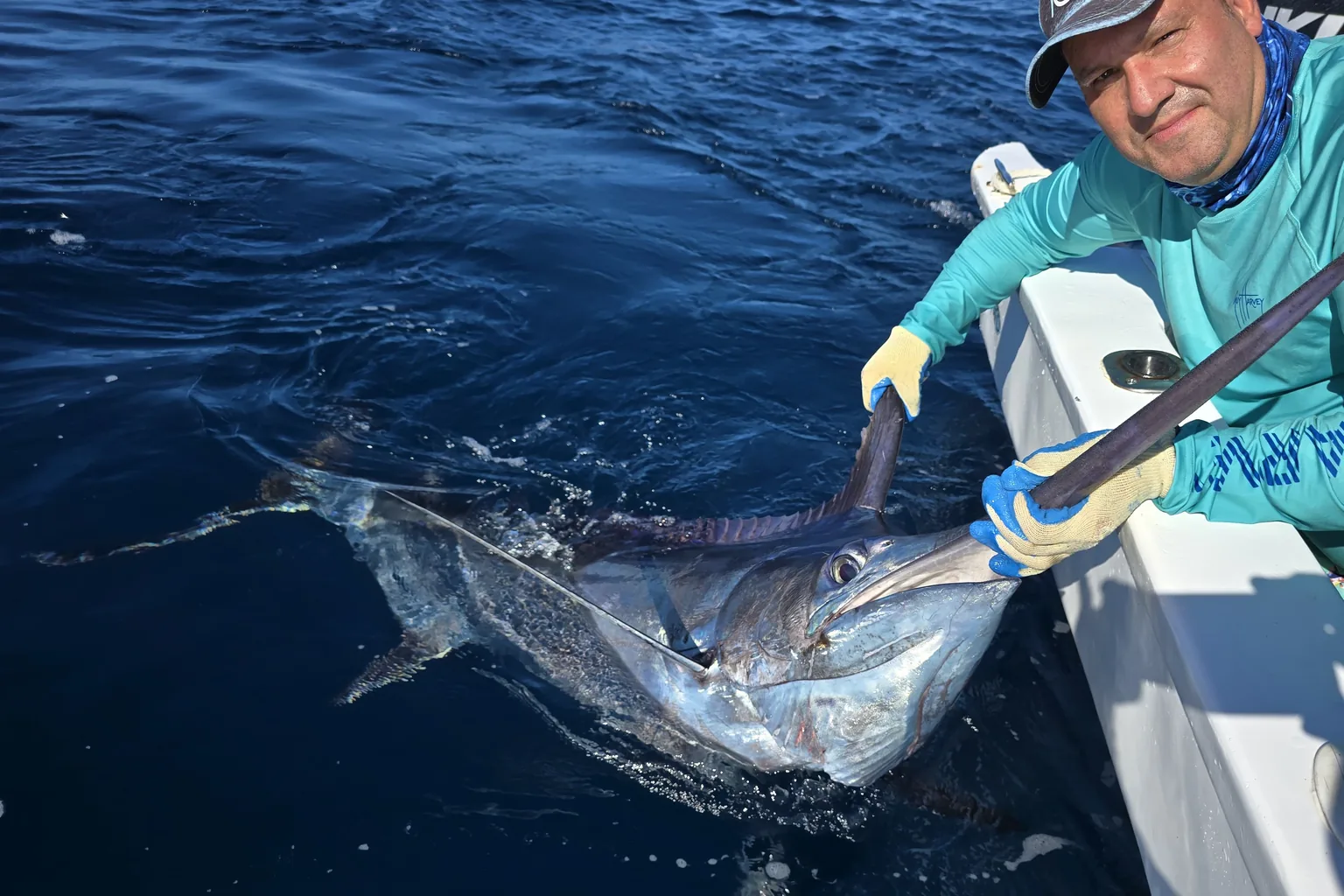
Every marlin and sailfish we catch is released, and it stays in the water next to the boat while the hook comes out. Whichever marlin it is, the crew helps you get a photo with the fish beside the boat, and the fish swims away. The crew will tell you which one it was, and it is a good story either way.
Which trip to choose
All marlin fishing is offshore, on Sol de Oro, trolling ballyhoo and lures 14 to 25 miles out at the drop-offs. Choose 4.5, six or eight hours. More hours give you more time where the fish are, not a promise of a marlin.