The sailfish is the fish most people picture when they think of fishing in Costa Rica, and it is the billfish most anglers come here hoping to see. Here is what makes it different from a marlin, when it is around Sámara, how a bite happens and why every one goes back in the water.
The sail
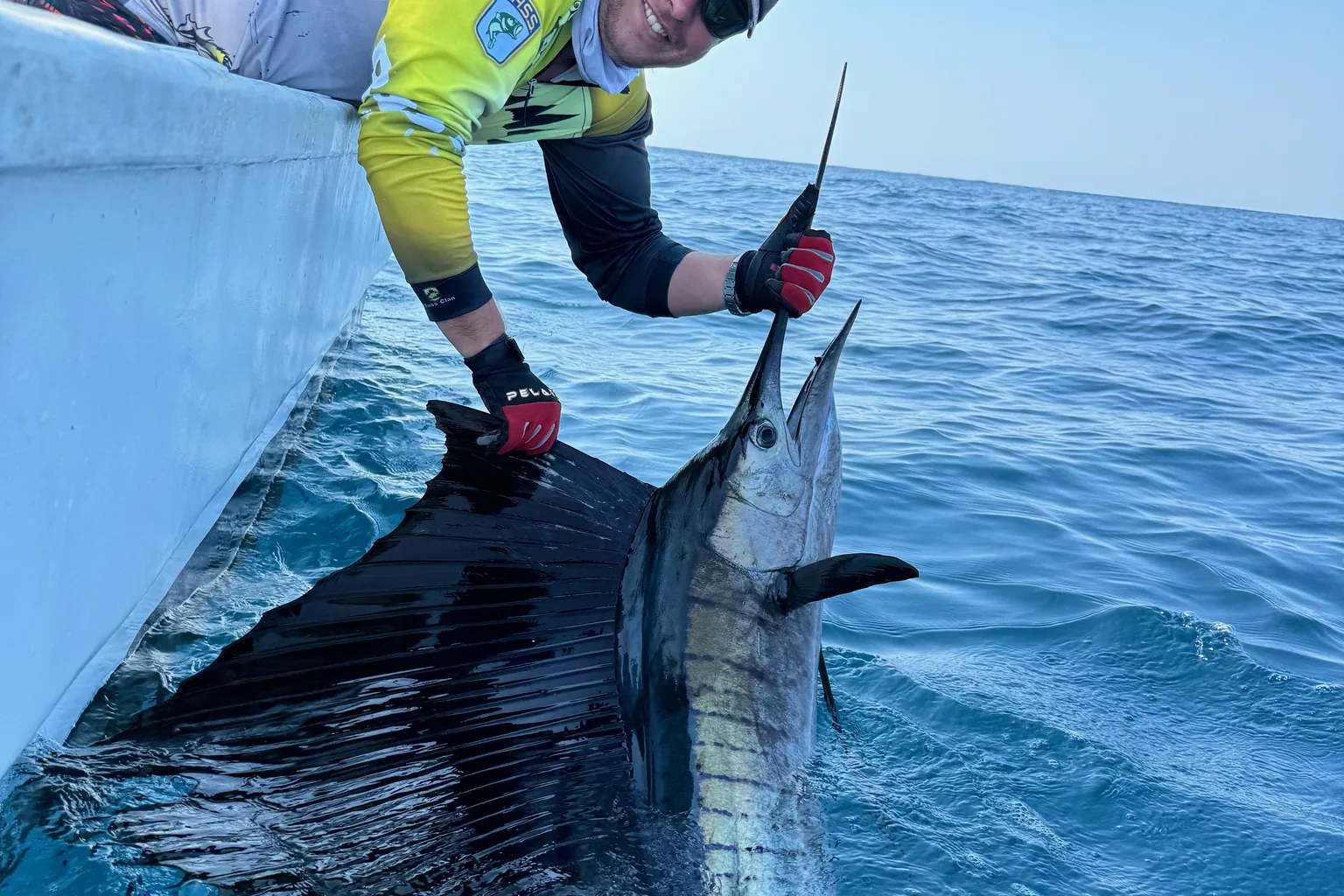
A sailfish has a long, thin bill and a huge fin along its back, taller than the body itself. Most of the time the sail lies folded down. The fish raises it when it is excited, when it herds small fish together to feed, and often when it is next to the boat. The body is dark blue on top and silver below, with light blue stripes that flash brighter during the fight. Next to a marlin, a sailfish is lighter and slimmer, and the sail gives it away at once.
Pacific sailfish
The sailfish of the Pacific grow larger than the ones in the Atlantic, and Costa Rica's Pacific coast is one of the best-known places in the world to catch them. Off Sámara they feed at the drop-offs, 14 to 25 miles out, where the sea floor falls away into deep water. All our offshore trips run there on Sol de Oro.
When they are around Sámara
Sailfish are strongest from December to April, and they are still good in July and August. From March to May marlin are at their best too, so a spring trip may see both. These are patterns we see, not promises. If a sailfish is the reason for your trip, tell us before you choose dates and we will say honestly what we are seeing.
The bite
We find sailfish by trolling ballyhoo and lures behind the boat. A sailfish often shows itself first: a dark shape and a raised sail behind a bait, slashing at it with the bill. When the fish takes the bait, the crew hands you the rod and clears the other lines. Then the sailfish jumps, often many times, and runs across the surface. Fights are fast and full of jumps, and a fish can throw the hook. That is part of it.
Released in the water, every time
Every sailfish we catch is released, and it stays in the water next to the boat while the hook comes out. We never lift it on board, because its body is not made to be lifted. The crew helps you get your photo with the fish beside the boat, so keep your phone or camera in a dry bag and ready. Our catch and release guide explains how it is done.
Which trip to choose
Choose an offshore trip on Sol de Oro: 4.5, six or eight hours, with lunch on the full day. You don't need experience: the crew guides every step.